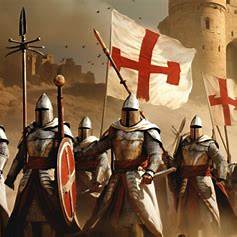
From warrior monks to power players to political pawns—this is their true story. And it’s way messier than the legend has led us to belive.
Why I’m Obsessed with the Middle Ages (and You Might Be Too)
Confession time: I’m a medieval history junkie. Toss me a crumbling manuscript, a shadowy relic, or a battle hymn sung by chainmail-clad monks, and I’m in my element.
But if there’s one rabbit hole I never tire of falling down, it’s the Crusades—a chaotic mix of divine mission, earthly ambition, and brutal pageantry. It’s all so wonderfully contradictory. Knights pledging purity, then charging into war. Sacred objects sparking rumors, pilgrimages, even wars.
And smack in the middle? The Knights Templar.
They weren’t just soldiers or saints. They were a paradox with a sword.
Origins: Holy Warriors in a Time of Chaos (1119–1129)
When Jerusalem fell to the First Crusade in 1099, Christian Europe rejoiced—and immediately booked travel. Pilgrims flocked eastward, only to face bandits and bloodshed on the roads.
Enter Hugues de Payens and Godfrey de Saint-Omer: Crusade veterans who pitched a new order to King Baldwin II in 1119. These wouldn’t be monks holed up in cloisters—they’d be armed defenders of the faithful.
Baldwin gave them lodging on the Temple Mount, formerly the Al-Aqsa Mosque—believed by many to sit atop Solomon’s Temple ruins.
Thus, the Poor Fellow-Soldiers of Christ and the Temple of Solomon were born. Catchy, right?
From the start, their purpose was soaked in sacred geography and holy fire.
The Rule of the Templars: Faith in Armor
The early Templars? Broke, devout, and deadly serious. So broke, in fact, their official seal showed two knights sharing one horse.
But they had believers in high places. In 1129, they earned papal backing, thanks largely to Bernard of Clairvaux—Europe’s top religious influencer at the time.
He framed the Templars as spiritual warriors, a holy counterpoint to Europe’s party-boy knights.
Their Latin Rule, modeled after Cistercian monastic codes, laid it out:
✅ Poverty
✅ Obedience
✅ Chastity
✅ No ego, no glory-seeking.
✅ Fight only when ordered.
✅ Protect pilgrims.
This wasn’t knighthood—it was crusading as a calling.
A Life Ruled by Rules: Templar Dos and Don’ts
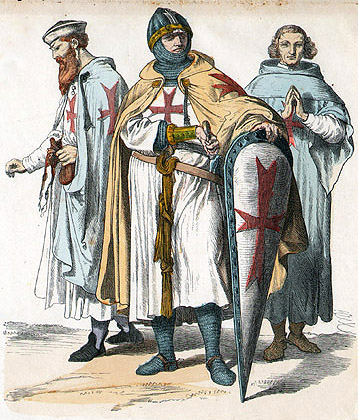
By the 1200s, the Templars had hundreds of rules—micromanagement on a divine level.
Flashy clothes? Forbidden. Fur-trimmed anything? Nope. Haircuts? Short and severe. Pointy shoes? A slippery slope to sin, apparently.
Silence reigned at meals, broken only by Scripture. Meat was rare. Wine? Rationed.
Pets were a no-go—especially dogs or falcons (too aristocratic). Even affection had limits: no kissing, not even Mom. The goal? Total control of body and soul.
Templar life was about stripping away self. No vanity, no distractions, no comforts—just mission.
The Templars’ Banking Brilliance
Somewhere between prayers and battlefield valor, the Templars invented international banking.
They amassed land, livestock, and fortresses via noble donations—earning Church tax exemptions and immunity from local oversight.
They operated like a sacred startup with Vatican backing.
But their real flex? Letters of credit. Pilgrims could deposit money in Europe and withdraw it safely in Jerusalem. It was a proto-traveler’s check—genius, really.
Eventually, kings tapped them as trusted bankers. Templars stored royal treasure, funded wars, and even advised monarchs.
In France and England, they basically ran the treasuries.
A military order? Sure. But also the medieval world’s most powerful private bank.
Daily Life of a Templar Knight
Forget tournament fanfare and feasting. Templar life was a grind.
Days started before dawn with prayer, followed by weapons drills, study, and more prayer. Seven services structured their day. Meals were communal, silent, and modest.
Even in battle, they rode in strict formation and followed commands without hesitation.
Each knight got three horses and several squires—but no frills.
White cloaks with red crosses? Yes.
Gold hilts, flowing manes, and swaggering bravado? Absolutely not.
Honor meant discipline. Vanity was vice. Capture? Accept torture. But never betray your brethren.
The Fall of the Templars: Greed, Politics, and a Friday to Remember

By the early 1300s, the Templars were rich, powerful—and increasingly redundant.
The Crusades had fizzled, but their banking empire thrived. With over 9,000 properties and unmatched financial clout, they had few friends and many jealous rivals.
Enter King Philip IV of France. Deep in debt to the Templars and in need of cash, Philip moved fast.
On Friday the 13th (yes, that Friday), 1307, he ordered mass arrests across France.
The charges? Heresy, idol worship, blasphemy, devilish rituals. Baphomet made his first appearance.
Under torture, many confessed. Most recanted. Too late.
Philip’s power play had begun.
The Trial and Execution
Philip leaned hard on Pope Clement V—then conveniently stationed in Avignon under his thumb.
In 1312, the Pope disbanded the Order under Vox in Excelso.
The Knights Hospitaller inherited their property, though Philip quietly snagged the choicest pieces.
In 1314, Grand Master Jacques de Molay and Geoffroi de Charney were burned alive in Paris.
Legend says Molay cursed the king and pope as flames rose—predicting their deaths within the year.
He wasn’t wrong.
The Aftermath: Secrets, Symbols, and Conspiracies
With the Order silenced, the myths exploded.
Did they hide the Grail?
Escape with gold-laden ships?
Morph into the Freemasons?
Protect Christ’s descendants?
Dan Brown and Hollywood certainly think so.
What’s fact, what’s fiction? Hard to say.
But one thing’s clear: the mystery kept them immortal.
Final Thoughts: Saints, Sinners, or Scapegoats?
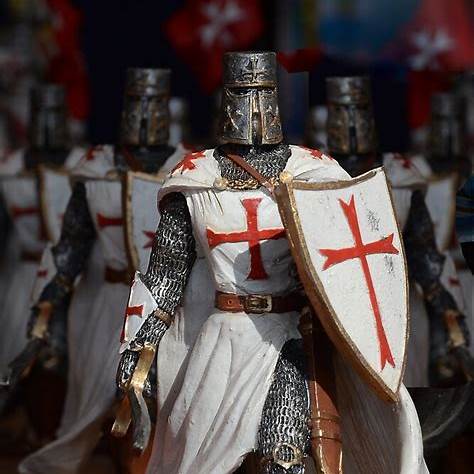
The Templars were complicated—devout and dangerous, principled and political.
Their rise was meteoric, their fall brutal. And yet, their legend outlives their bones.
They remind us that faith and power make a volatile mix—and that truth is often the first casualty of ambition.
📚 Sources & Further Reading
- The Trial of the Templars — M. Barber
- The Knights Templar: A Brief History — H. Nicholson
- The Real History Behind the Templars — S. Newman
- The Rule of the Templars — J.M. Upton-Ward
- Knights Templar Encyclopedia — K. Ralls
💬 Join the Order (of Commenters)
Got a wild Templar theory? Want to debate their fall? Found a sword in your attic?
🗡️ Drop a comment.
🔗 Share with your fellow Crusade nerds.
📬 Subscribe for more medieval deep dives.
And if you do stumble on Baphomet… maybe just leave it in the basement.
 Sally the Scribe
Leave a comment