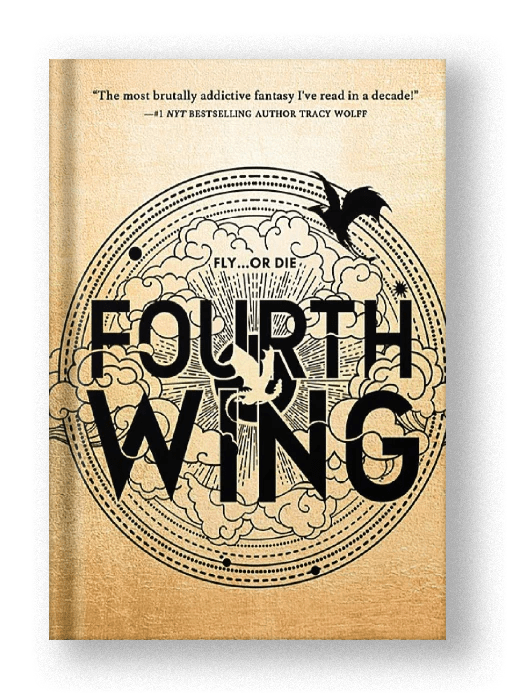
Spoiler Warnings Ahead!
When Fourth Wing first blazed onto the scene, it felt like the ultimate case of hype run amok: dragons, dark academia, deadly trials, enemies-to-lovers tension, betrayals layered like a dagger to the gut, and a heroine caught between survival and rebellion. I was skeptical. In the age of viral BookTok sensations and Instagram-perfect reels, it’s all too easy for a story to dazzle briefly and then collapse under the weight of its own expectations. But then I cracked it open. Two chapters in, and I knew: Rebecca Yarros wasn’t just fanning a few flames—she was burning the whole forest down.
What makes Fourth Wing so utterly addictive isn’t just the dragons, the death-defying stunts, or the brooding, beautifully broken heroes (though, let’s be real, they definitely help). It’s the sheer force of Yarros’ writing. She doesn’t weave elaborate metaphors or build ornate linguistic cathedrals; she writes with a blade, not a paintbrush. The first-person present tense—which often feels gimmicky in less confident hands—is urgent and alive here. Violet’s voice crackles off the page, raw and immediate. Every gasp, every bone-deep betrayal, every desperate, reckless heartbeat lands straight in your bloodstream.
That said, the book isn’t flawless. In her headlong rush to keep the story barreling forward, Yarros sometimes trades depth for speed. Snappy modern dialogue occasionally bumps awkwardly against the medieval-inspired backdrop, jarring you out of the illusion. And the breathless pace, while thrilling, sometimes flattens the worldbuilding outside Basgiath’s iron walls. Navarre is vivid in flashes—like a battlefield at twilight, drenched in blood and fire—but beyond that? The edges blur. It’s a place you feel, rather than fully see.
But here’s the thing: you forgive it. You forgive every slip because of how fiercely Fourth Wing grabs you by the collar and refuses to let go. It’s not trying to be perfectly sculpted; it’s trying to make you feel something real—and it succeeds, spectacularly. Before you know it, you’re staying up far past midnight, chasing “just one more chapter” until dawn breaks and the birds start mocking your sleepless devotion.
Beyond the adrenaline and the aching romance, Fourth Wing sneaks in a surprisingly sharp political undercurrent. At first, Navarre looks like standard fantasy fare: a militaristic society fending off an existential threat. But Yarros quickly peels back that façade. What she reveals is a brutal system that worships strength and exterminates weakness without apology. Basgiath isn’t just a crucible—it’s a machine designed to grind the vulnerable into dust, and call it destiny.
Violet’s struggle against that machine is where Fourth Wing truly bites. She is a rebellion wrapped in bruises and stubbornness. In a world where muscle and violence rule, Violet dares to wield intelligence and strategy as weapons. The echoes to real-world authoritarianism are chilling—the way power distorts truth, rewrites history, and demands blind obedience. Violet’s arc isn’t just a personal coming-of-age; it’s a political awakening, a slow, terrifying realization that loyalty to the wrong cause isn’t honor—it’s complicity.
And yet, for all its serious undercurrents, Fourth Wing never forgets to entertain. It’s buoyed by a cast of characters that feel gloriously messy and fiercely alive.
At the heart is Violet Sorrengail—a heroine who will spark fierce debate, but who captured me completely. Violet is not secretly invincible. She’s not some hidden super-soldier or lost royal. She’s small, injured, often terrified—and she fights anyway. Her strength isn’t a magical gift; it’s a daily, brutal choice. To move. To endure. To resist.
And then there’s Xaden Riorson: brooding, dangerous, whip-smart, and carrying enough emotional baggage to sink a fleet. Their dynamic is deliciously slow-burn: mistrust sparking into reluctant respect, hardening into anger, flaring into something far riskier. When they finally collide, it’s not just about chemistry—it’s about all the hope, fury, and fear they’ve kept caged too long. It’s messy and raw and utterly earned.
The spiciness of Fourth Wing deserves its own slow, appreciative nod. Yarros doesn’t just throw in heat for the sake of it. When Violet and Xaden’s walls finally crack, it feels seismic. It’s not just passion—it’s vulnerability exposed, two warriors daring to need someone in a world that punishes weakness mercilessly.
And oh, Riddoc.
If Violet is the beating heart of Fourth Wing and Xaden its stormcloud, Riddoc is its brightest, most defiant spark. Quick-witted, fiercely loyal, and armed with a humor that slices through the darkness like a blade, Riddoc reminds us that laughter can be resistance too. In a school built to break its students, he refuses to let cruelty steal his light. His friendships anchor the story, a reminder that surviving isn’t enough—you have to live.
Without him, Fourth Wing would still be breathtaking. With him, it becomes something richer: a story that knows joy and sorrow aren’t opposites—they are each other’s necessary twin.
As the book races toward its climax, secrets detonate. Trust shatters. And just when you think you’ve steadied yourself, Yarros yanks the rug out from under your feet with a final twist that left me reeling, heart hammering in my chest. It’s a risk. It redefines everything. And it’s exactly the kind of narrative audacity that makes Fourth Wing linger long after you close the last page.
Reading Fourth Wing isn’t a calm experience. It’s breathless. It’s wild. It stumbles sometimes—but it also soars, higher and harder than most of its more “polished” peers, because it dares to feel everything so fiercely. In a genre that can often feel cynically over-engineered or weighed down by endless lore dumps, Rebecca Yarros offers something electric: a story lit by heart, hunger, fury, and hope.
And dragons. Always, always the dragons.
 Sally the Scribe
Leave a comment