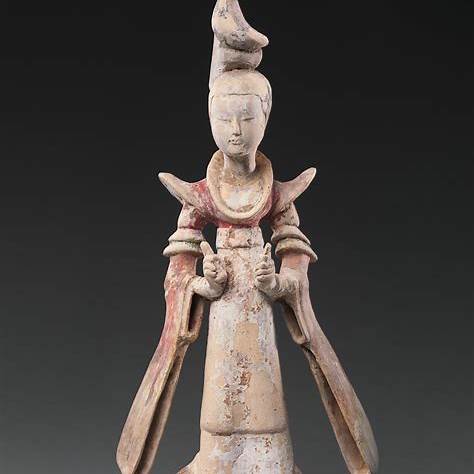
My Tang Dynasty Fascination: From Classroom to Court Wonders
My fascination with the Tang Dynasty didn’t start with some grand epiphany—it happened in a college classroom, during a Chinese Civilization course I took to check off a requirement. What began as a box to tick for my history degree slowly grew into a deep, enduring admiration for one of the most sophisticated and unexpectedly high-tech chapters in human history.
Between the poetry, the glittering court life, and the multicultural bustle of its cities, one element captured my imagination and never quite let go: the automatons—mechanical wonders that walked, bowed, chirped, and poured wine centuries before anyone thought to define the word “robotics.”
These weren’t fables or philosophical abstractions. The Tang Dynasty (618–907 CE) was alive with innovation, and some of its genius took shape—sometimes quite literally—as machines that seemed to breathe with life.
A Glorious Age: The Tang Dynasty in Context
Often hailed as one of China’s greatest imperial dynasties, the Tang period earned that title for good reason. Its capital, Chang’an—now Xi’an—was the largest city in the world at the time, humming with merchants, monks, artists, and scholars thanks to its prized position along the Silk Road.
Culturally, the era was a supernova. Poets like Li Bai and Du Fu shaped the soul of Chinese literature. Buddhism blossomed into golden age brilliance, filling caves and temples with celestial art. Confucian order and Daoist thought shaped governance and spiritual life alike. The civil service exams were institutionalized, and Tang law set blueprints future dynasties would follow for centuries.
But amid this outpouring of human genius, something unusual stirred—machinery that mimicked life itself.
Tang Automatons: Ingenious, Artistic, Alive
An automaton, by definition, is a self-moving machine that carries out tasks on its own—sometimes eerily close to lifelike behavior. While today we associate them with factory arms or theme park attractions, in the Tang era, automatons were feats of both engineering and artistry—mechanical masterpieces layered with symbolism and theatricality.
These devices were animated by ingeniously concealed systems—water-driven gears, counterweights, levers—that allowed them to move, flap, sing, or pour wine without human touch. Picture a gilded bird trilling or a sculpted maiden offering a goblet, all set in motion not by magic, but by pure mechanical wizardry—in the 700s.
Serving Elegance: The Drink-Pouring Machines of Court
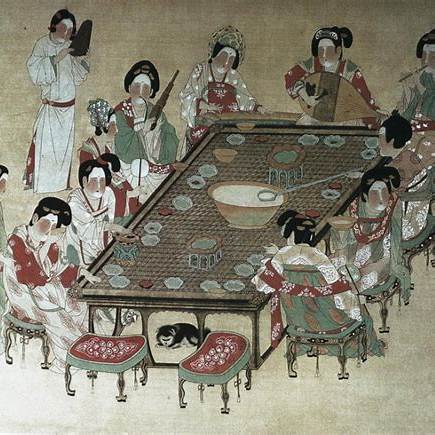
Among the most whimsical and enchanting creations were the wine-serving automatons gracing royal banquets. They were more than toys—they were prestige pieces, marrying function and showmanship in ways that left guests slack-jawed.
One of the best-known examples comes from the opulent reign of Emperor Xuanzong (712–756), a ruler who cherished spectacle. His feasts were lavish productions, often featuring music, dance, and these delightful machines.
At such events, it wasn’t a servant who brought your drink—it might be a golden bird or a mechanical dancer gliding across polished floors. A favorite design featured a mechanical wine-server that rolled forward on hidden wheels, bowed, and delicately tipped a jug into your cup before wheeling away or turning to the next guest.
Some setups included small fountains dispensing wine at set intervals or channels carrying cups along flowing water—a kind of proto-conveyor belt that makes modern sushi trains seem derivative.
But beyond the engineering, these creations sent a message: that Tang China was a center of culture, intellect, and might, able to dazzle not just with poetry or military power, but with machines that could rival the imagination.
Powered by Water, Driven by Genius
Many of these devices drew power from water—a tradition stretching back to earlier dynasties. Since Han times, Chinese inventors had harnessed water for mills and clocks. By the Tang era, the same principles found playful new life in entertainment.
Think of Ma Jun’s south-pointing chariot from the Three Kingdoms era, which used differential gears—a technical foundation the Tang retooled for pleasure.
The wine-serving automatons likely relied on a clever interplay of weights, water pressure, and levers to trigger timed movements. Pressure might tilt a vessel just enough to pour, open a compartment, or propel a cart forward. Timing and surprise were part of the spectacle, designed to both impress and delight.
Engineers and Inventors of the Tang Court
Although the names of Tang-era inventors are less well-known than their Song or Han counterparts, historical records suggest that the imperial court employed a number of mechanical engineers, artisans, and craftsmen whose skills were highly prized.
Craftsmen known as “ji jiang” (mechanical artisans) worked alongside astrologers, architects, and ritual specialists to design devices for palaces, festivals, and temples. These artisans likely collaborated on constructing automata for use in imperial banquets and religious rituals, drawing from earlier Chinese engineering knowledge while innovating in form and function.
Emperor Xuanzong is said to have had an entire bureau for palace entertainment, which included mechanical designers. While their individual names may be lost to history, their legacies live on through travel accounts, surviving literature, and the awe they inspired in observers.
Even more broadly, the Tang mechanical tradition drew heavily on earlier inventors like Zhang Heng, the Han dynasty astronomer who created the world’s first seismoscope, and Ma Jun, whose geared inventions prefigured Tang-era automatons. These innovators helped lay the foundation for the Tang’s golden age of kinetic art.
Machines in Temples and Theaters
Though court banquets were ideal for such wonders, temples and stages also featured intricate automatons. In Buddhist temples, machines enacted celestial narratives—rotating star maps, divine figures in synchronized movement—all powered by flowing water and hidden gears.
These weren’t sideshow tricks. They symbolized harmony in the cosmos, bringing spiritual lessons to life with movement and metaphor.
In court theaters, automatons might “emerge” from beneath the stage, birds could soar across the rafters, or dragons might breathe steam like living creatures. The blending of technology and myth made performances magical in more ways than one.
The World Watches—and Learns
At its peak, Chang’an was arguably the most cosmopolitan city on Earth. Diplomats and traders from Persia, India, Central Asia, even Byzantium, brought stories home of what they saw—and among those tales were accounts of these wondrous machines.
Arab scholars like al-Jahiz and Ibn Rustah wrote about strange devices in China, almost certainly inspired by what they encountered at Tang courts. Their descriptions, though sometimes romanticized, fueled imaginations from Baghdad to Córdoba.
It’s not far-fetched to believe that along with silk and paper, knowledge of these automatons made its way westward, eventually influencing Islamic engineers like the Banū Mūsā brothers or al-Jazari—pioneers whose automata would, in turn, inspire European thinkers of the Renaissance.
The Legacy of Tang Automatons
While the physical automatons of the Tang Dynasty have not survived, their influence carried forward. The Song Dynasty (960–1279), in particular, became a hotbed for mechanical innovation, with more detailed documentation and the famous astronomical clock towers designed by Su Song.
Su Song’s water-powered celestial clock tower, completed in 1090, included mechanical puppets, bell strikers, and rotating armillary spheres. It was a direct continuation of the Tang tradition of combining timekeeping, spirituality, and showmanship through machine design.
Even centuries later, Ming and Qing inventors built on these traditions. European Jesuits visiting China in the 16th and 17th centuries marveled at the complexity of Chinese water clocks and automata—some of which were older than any comparable Western technology.
Globally, Chinese automaton culture influenced Islamic engineers who preserved and expanded upon earlier designs in texts like the Banū Mūsā’s “Book of Ingenious Devices” and al-Jazari’s “Book of Knowledge of Ingenious Mechanical Devices.” These, in turn, reached Europe during the Renaissance, fueling the imaginations of inventors like Leonardo da Vinci.
The thread stretches across cultures and centuries, but one of its strongest and earliest weaves begins in the Tang court.
Machines That Echo Philosophies
To ancient Chinese thinkers, machines that mimicked life weren’t just curiosities. They raised real philosophical questions. Daoist and Confucian scholars pondered the boundary between imitation and reality. Could a crafted bird truly sing? Was mechanical mimicry a celebration of nature, or a violation of it?
These debates feel strikingly modern—mirrored in today’s conversations around AI, robots, and synthetic life. The automatons of the Tang were not just clever novelties; they were the beginnings of a much deeper inquiry into the human relationship with technology.
The Future, Whispered from the Past
What continues to astonish me isn’t just that Tang engineers built these machines, but that they did so with such beauty and imagination. These weren’t gimmicks. They were proof of a society brimming with confidence, curiosity, and creative might.
Automatons that bowed and poured wine weren’t merely entertaining—they were statements. In the candlelit grandeur of Tang palaces, amid music and silk, birds sang on cue, dragons flowed wine, and gears turned unseen.
In those moments, the Tang weren’t just delighting guests. They were quietly reaching across time—into ours.
Sources
Needham, Joseph. Science and Civilization in China, Vol. 4: Physics and Physical Technology, Part 2. Cambridge University Press, 1965.
Temple, Robert. The Genius of China: 3,000 Years of Science, Discovery, and Invention. Simon & Schuster, 1986.
Graham, A.C. (Trans.). The Book of Liezi. Columbia University Press, 1990.
Liu, Xinru. The Silk Road in World History. Oxford University Press, 2010.
Elvin, Mark. The Pattern of the Chinese Past. Stanford University Press, 1973.
Benn, Charles. China’s Golden Age: Everyday Life in the Tang Dynasty. Oxford University Press, 2002.
Ennin. The Record of a Pilgrimage to China in Search of the Law (Nitto Guhō Junrei Kōki).
Hill, Donald R. Arabic Water-Clocks and Automata in the Medieval World. 1981.
Saliba, George. Islamic Science and the Making of the European Renaissance. MIT Press, 2007.
 Sally the Scribe
Leave a comment