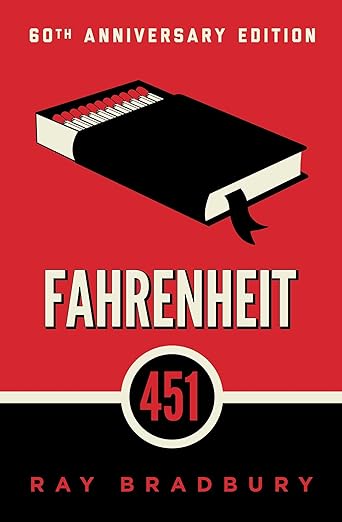
ay Bradbury’s Fahrenheit 451 stands as one of the most enduring, unsettling, and eerily accurate novels of the 20th century. First published in 1953, this dystopian landmark hasn’t lost its edge. If anything, its relevance has only sharpened with time. The book’s lasting grip on readers isn’t just about its dystopian premise—it’s the way Bradbury taps into the undercurrents of censorship, cultural conformity, and technological distraction with such prophetic clarity. His world—where books are banned, thinking is dangerous, and firemen ignite instead of extinguish—serves not only as a dire warning of totalitarian futures, but also as a mirror reflecting age-old fears and modern complacencies.
At the heart of the novel is Guy Montag, a fireman who doesn’t rescue, but destroys. In a society where books are treated like contraband, Montag initially embraces his role, unthinking and assured. But that certainty begins to erode after he meets Clarisse McClellan—a curious, questioning teenager who sees the world through unfiltered eyes. Her presence acts as a catalyst, unlocking something long dormant within Montag. His slow unraveling becomes a journey toward self-awareness, sparked by the very words he was ordered to destroy. Books become his refuge, his rebellion, his reawakening.
What makes Fahrenheit 451 resonate so profoundly today isn’t just the idea of literal book burning—though battles over banned books rage on—but the quieter, more insidious loss it portrays: the loss of critical thought. In Bradbury’s imagined future, people haven’t merely had books taken from them—they’ve stopped wanting them. Massive screens dominate every wall. Noise is constant. Earbud-like devices flood the mind with distraction. Depth gives way to speed. Thinking is not forbidden so much as forgotten. It’s a vision disturbingly close to our own, where passive consumption often crowds out deeper engagement.
And yet, Bradbury doesn’t preach. He writes with the sensitivity of a poet, not the hammer of a politician. His sentences shimmer with metaphor and movement. Fire in his story is never just fire—it’s beauty, it’s danger, it’s transformation. His language doesn’t simply describe; it seduces, unsettling and hypnotic in equal measure. What he builds with words is more than a cautionary tale—it’s a myth, a parable wrapped in science fiction, pulsing with existential urgency. Montag’s transformation isn’t merely personal; it’s symbolic, a flicker of hope against overwhelming darkness.
Bradbury, who grew up during the Great Depression and educated himself in public libraries, wasn’t just writing a story about censorship. He was issuing a warning about a deeper threat: the erosion of curiosity, the self-inflicted silencing that comes from apathy. He feared not just governments controlling information, but people choosing ignorance—rejecting knowledge not because it’s banned, but because it’s inconvenient. That’s where Fahrenheit 451 gets its real power—from its insights into the quiet psychology of surrender.
Though shaped by Cold War anxieties—McCarthyism, propaganda, the pressure to conform—Bradbury’s themes float free of their original era. His critique isn’t locked into left or right politics. Instead, he challenges all forms of extremism and comfort-driven thoughtlessness. He warns against exchanging freedom for safety, nuance for certainty, reality for entertainment. Fahrenheit 451 isn’t just a dystopia—it’s a plea for intellectual courage.
In a time when content overwhelms, when outrage drowns out understanding, Bradbury’s novel asks readers to pause. To sit with discomfort. To value complexity. It reminds us that information isn’t wisdom, and that truth often resists being simplified into trending hashtags or bite-sized reels. The firemen in Bradbury’s tale don’t just destroy stories—they sever our ties to memory, to shared history, to the connective fibers that give life meaning. Montag, by resisting, becomes a spark—a reminder that the human spirit can still burn brightly, even when the world goes dim.
Technologically, we’ve outpaced Bradbury’s predictions. But emotionally and culturally, his concerns still echo. We may not have parlors with wall-sized TVs exactly as he envisioned, but we do have devices in our pockets that rarely leave our hands. We may not burn books in the streets, but algorithms quietly push challenging ideas out of sight. Still, Bradbury leaves room for hope. The “book people” who memorize texts become stewards of culture, keepers of memory, vessels for resilience.
For today’s readers—whether students, creators, or casual browsers—Fahrenheit 451 is more than assigned reading. It’s a challenge to stay awake, intellectually and emotionally. It’s an invitation to question, to rediscover the quiet defiance of reading deeply. It dares us to think—and more importantly, to care. Bradbury’s fire doesn’t only destroy. It purifies. It transforms. It points us forward.
Viewed through a literary lens, the novel stands as one of speculative fiction’s great achievements. Bradbury’s prose is lyrical, precise, and profoundly alive. He rarely leans on exposition; instead, he lets images and atmosphere carry his message. His themes resonate across generations, and the experience of reading Fahrenheit 451 changes as the reader does. Read it young, and it’s a thrilling dystopia. Read it later, and it becomes something else entirely—layered, mournful, urgent.
More than a novel, Fahrenheit 451 is a testament to why stories matter. It’s a love letter to language, to memory, to the wild and fragile act of thinking for yourself. In a world spinning faster by the day, Bradbury’s voice lingers, quietly asking us to slow down. To read. To remember. To think.
 Sally the Scribe
Leave a comment