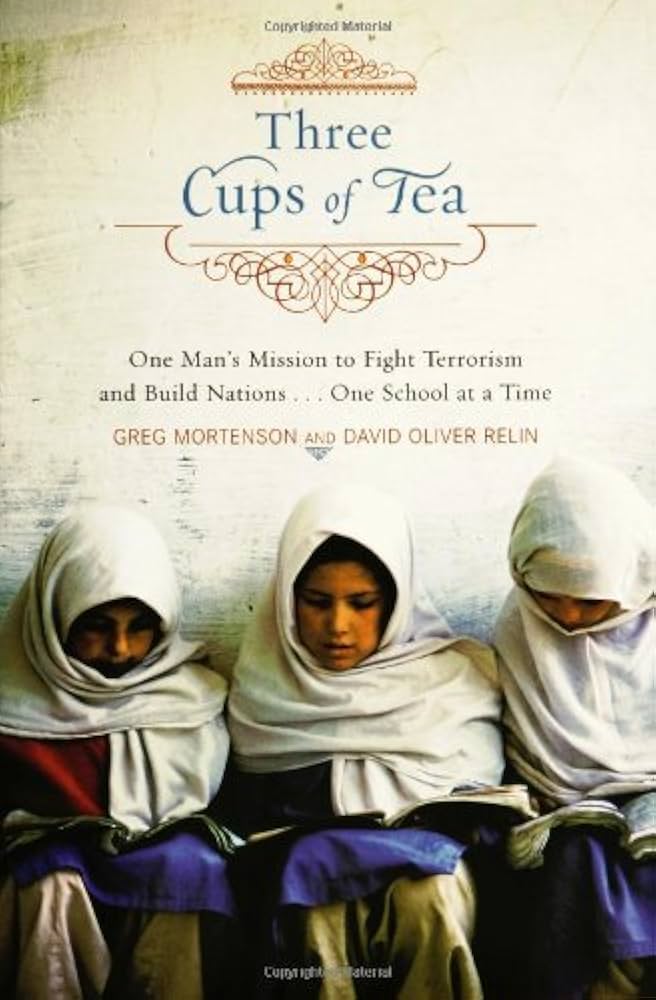
Three Cups of Tea by Greg Mortenson and David Oliver Relin offers a compelling narrative centered on Mortenson’s mission to build schools in the mountainous regions of Pakistan and Afghanistan. The book not only chronicles the creation of the Central Asia Institute (CAI) but also sheds light on the broader socio-political turmoil in the Middle East. At its core, the story champions a deceptively simple yet powerful belief: education—especially for girls—is the most effective tool in combating poverty and terrorism.
Published in 2006, the book quickly gained traction among educators, policymakers, and humanitarian advocates. It became a staple in classrooms and military training programs, hailed as an example of peaceful intervention and grassroots diplomacy. Mortenson’s vision—to replace bombs with books and guns with pencils—resonated widely in a post-9/11 world. For many Western readers, this was a rare glimpse into the everyday lives of people in regions frequently portrayed through the lens of conflict and extremism.
Spanning from 1993 to the early 2000s, the book opens with Mortenson’s failed attempt to climb K2 and his subsequent promise to build a school for the villagers of Korphe. What follows is a decade-long journey of school-building efforts, community engagement, and cross-cultural connection. The narrative follows a chronological structure but frequently detours into anecdotes and character sketches, weaving a complex, human tapestry around its central theme.
While its heart is in the right place, Three Cups of Tea has not been without criticism. The most significant controversy centers around allegations that portions of the book were fabricated. Investigations by 60 Minutes and journalists from The Guardian and The New Yorker raised serious doubts about key elements in the story—most notably, Mortenson’s supposed kidnapping by the Taliban, which was later challenged by local sources. Additionally, there were concerns over the financial mismanagement of the CAI, with critics claiming that donations were not being properly used for the schools they were intended to support. A 2012 settlement with the Montana Attorney General’s office required Mortenson to repay over $1 million to the foundation.
These revelations have complicated the book’s legacy. Originally embraced by educators, aid workers, and even the U.S. military as a model of grassroots diplomacy, the story is now often cited as a cautionary tale about unchecked hero narratives and the lack of oversight in nonprofit fundraising. Mortenson’s portrayal as an infallible savior figure has since been reassessed, with critics calling for a more nuanced view of both the man and his mission.
Despite these shortcomings, the book remains an impactful introduction to issues often misunderstood in the West. One of its most admirable qualities is the nuanced depiction of the people and culture of the Middle East. It refuses to stereotype or villainize and instead explores the motivations behind extremism, including the rise of radical madrassas, deep-rooted poverty, and decades of regional instability. Characters like Haji Ali—a village elder who becomes a key ally—and even a former Taliban member are presented with complexity and empathy.
Equally notable is the book’s focus on gender equity. One of Mortenson’s central arguments is that educating girls is the most transformative and long-term solution to both poverty and extremism. Girls who are educated contribute more actively to their communities, are less likely to be radicalized, and often become advocates for future generations. Through stories of young women returning to their villages with medical or teaching skills, the book illustrates how knowledge has the power to reshape entire communities.
From a stylistic standpoint, Three Cups of Tea employs a tone that is both accessible and emotionally resonant. The prose often blurs the line between biography and advocacy, creating a reading experience that is as much about inspiration as it is about information. Relin, a journalist by trade, leans heavily into the conventions of narrative nonfiction. Vivid descriptions, dramatic pacing, and personal interviews drive the book forward, making complex geopolitical themes digestible for a general audience. However, the same journalistic flair that makes the book readable also opens it up to scrutiny—particularly when storytelling takes precedence over factual accuracy.
The book’s approach aligns with a tradition of humanitarian storytelling that seeks to move readers emotionally to action. This can be effective, but also problematic when the central figure is elevated without critique. Three Cups of Tea stands as a reminder that compelling stories can simultaneously enlighten and mislead—and that readers must balance inspiration with investigation.
This book serves as an entry point for those interested in the intersections of education, development, and international relations. Its readable format and moral clarity make it suitable for educators, students, and global studies programs. It encourages readers to reconsider their assumptions about Islam, the people of Central Asia, and the roots of extremism. However, it is best approached with a discerning eye and an awareness of the broader context surrounding its creation and reception.
Even with its flaws, Three Cups of Tea succeeds in sparking important conversations—about aid, about cultural respect, and about the role education plays in global peacebuilding. And in that way, its contribution remains significant.
 Sally the Scribe
Leave a comment