⚠️ Spoiler Warning:
Minor spoilers ahead, especially about the setting, magic system, and character arcs. Major plot twists and endgame spoilers are avoided—but if you’re a purist, go grab the books first and come back later!
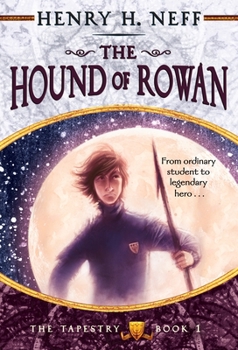
There are fantasy books you enjoy, and then there are fantasy books that quietly set up camp in your head and never leave. The Tapestry series by Henry H. Neff is one of the latter. It’s criminally underrated—overshadowed in the 2000s by more commercial magic school fare—but those who know it, know. And if you’re a fantasy fan who craves mythological depth, character-driven storytelling, and a school setting that feels actually alive and dangerous, you’re in for a treat.
I picked up The Hound of Rowan expecting something in the same vein as Harry Potter, maybe with a Celtic twist. What I got was darker, stranger, and way more emotionally complex. Neff isn’t just telling a schoolboy-wizard story—he’s crafting an epic that weaves ancient mythology, secret societies, monsters, and moral ambiguity into a single, cohesive tapestry (pun fully intended). And instead of drawing from the usual suspects—Greek or Norse mythology—he reaches into the misty corners of Irish legend, Sumerian demons, and Judeo-Christian apocrypha. At the time, fantasy literature wasn’t giving much stage time to Irish myth beyond the occasional faerie cameo. Neff, on the other hand, builds his entire magical world on its bones.
Take Rowan Academy. The school is nestled in New England, but its soul is rooted in the arcane. It’s not just a setting—it’s a character in its own right. Each student is sorted into one of five dormitories, but instead of some talking hat or abstract traits, the dorms respond to the student. They change and adapt. One room might be cozy and book-lined for a scholar, while another is all stone and steel for someone who thrives on structure. That level of detail isn’t just cool—it’s personal. And it sets the tone for a school that’s built to push its students to their limit, not coddle them.
Rowan isn’t just a school for wand-waving and charm casting, either. Students train with weapons. They study the anatomy of magical beasts. They practice illusions and psychic defenses. There’s a whole bestiary, complete with a magical caretaker who makes Hagrid look like a substitute teacher on casual Friday. The creature care scenes are some of my favorites in the early books—not just because the beasts are fascinating, but because you can tell Neff enjoys the weird and wild side of magic. It’s not all spellbooks and sigils—there’s danger, mess, unpredictability.
Oh, and did I mention the sport? Forget Quidditch. Rowan has Pathfinder, which is basically magical gladiatorial capture-the-flag with monsters, illusions, and strategy. It’s brutal. It’s loud. And it’s taken very seriously. Matches are packed with suspense and magic-based misdirection. It’s one of the ways Neff reinforces the tone of the school: this isn’t a whimsical escape; it’s training for survival.
But the magic in The Tapestry isn’t confined to school grounds. As the story grows, the world expands, and we start to meet creatures far older and darker than anything Rowan has prepared Max for. The demons—or more accurately, the *demons Neff borrows and reinvents from ancient Mesopotamian, Irish, and biblical tradition—*aren’t just monsters to be slain. They’re intelligent, patient, and often deceptive. Trickery is a recurring theme in the series. Some of the most haunting moments come not from battles, but from betrayals, illusions, or choices made with incomplete information. There’s one especially chilling scene involving a possession that turns out to be… not quite what you expect. And it changes the way you view an entire character arc.
Max, the protagonist, begins as a kid from Chicago who stumbles into a magical world—but over five books, he becomes something far more complicated. His power is tied to ancient forces he doesn’t fully understand, and that burden changes him. What I love most is that Neff doesn’t shy away from that transformation. Max isn’t just “the chosen one.” He’s a weapon, a symbol, a possible threat. You feel every bit of tension as he struggles with what he’s becoming. Watching him wrestle with those internal conflicts made me feel like I was growing up right alongside him.
And then there’s the cast of supporting characters, which is where Neff truly excels. It’s rare to find a series where side characters aren’t just fun but vital. David, Connor, Nigel, Mum, Ms. Richter, the other dorm heads—all of them feel real. But there’s one that deserves special mention: Jimmy. Sweet, awkward, fiercely loyal Jimmy. He starts off as comic relief, the kind of character you expect to survive through sheer pluck and plot armor. But Neff doesn’t play that game. What happens to Jimmy hurts. It’s not played for shock—it’s meaningful. And it speaks to one of the central truths of The Tapestry: power has a cost, and not everyone gets a heroic arc. When I say I cried, I mean ugly cried. Rest in peace, Jimmy, you absolute legend.
Neff’s writing style also deserves more credit than it gets. It’s clean and vivid—perfect for younger readers—but layered enough for adults to appreciate the nuance. He knows how to build tension, when to go lyrical, and when to cut deep. The prose evolves with the story. As Max matures, so does the voice. By The Maelstrom and The Red Winter, the language carries the weight of the world’s unraveling. There’s this eerie, apocalyptic tone that seeps into the pages, and it works beautifully.
If I had to boil down why this series stands out so much, it’s because it’s ambitious in all the right ways. It juggles myth and magic, trauma and triumph, war and wonder. It gives kids credit for being able to handle difficult questions—about identity, sacrifice, loyalty, and destiny—without ever turning preachy. And it gives adults a reminder that fantasy doesn’t have to choose between fun and depth.
So if you’ve never read The Tapestry, now’s the time. Go in for the secret school and magic duels. Stay for the heartbreak, the lore, the battles, and the beauty. And when you get to that one scene, you’ll know the one—I’ll be here, quietly sobbing over Jimmy and lighting a candle for everyone we lost along the way.
 Sally the Scribe
Leave a comment