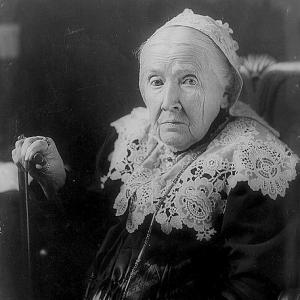
Julia Ward Howe always knew she wanted to be a writer, a rare profession for a woman at the time. In her memoirs, she wrote that “… a vision of some important literary work which I should accomplish was present with me in my early life and had much to do with habits of study acquired by me in youth, and never wholly relinquished. … but women writers were by no means as numerous sixty years ago as they are today. Neither was it possible for a girl student in those days to find that help and guidance toward a literary career which may easily be commanded today.” (Howe, Reminiscences, 1819–1899, 97).
What Julia could not know is that not only would her writing stand the test of time, her work an American standard, but that her life would become a beacon for the women who had no guidance. She would not just be a writer but a renowned suffragist as well, fighting for women to have the same rights and opportunities as men.
Early Years
Julia Ward Howe was born May 27th, 1819; the fourth of seven children, six of whom would live to adulthood. She was doted on by her elder brothers, Samuel, Francis, and Henry while being greatly admired by younger sisters Annie and Louisa. Her elder sister, also named Julia for their mother, had died at the age of three (Showalter 9). Her father, Samuel Ward, was a banker of great wealth, and her mother, Julia, was a poetess and philanthropist involved in The Society for the Promotion of Industry Among the Poor.
Her earliest years were spent at number 5 Bowling Green in Manhattan, at what was to become known as Nob’s Row. In those days, her family spent extravagantly and had the very best of everything, including a carriage worth $1,000. Julia took walks with her nurse around Battery Park and sometimes at night was allowed to be brought down to her parents’ lavish parties with grand orchestras and delicious treats; surrounded by noble and affluent guests who doted on her (Showalter 9–10).
These magical times were not to last. Her mother became ill and would die in childbirth on November 11th, 1824 (Showalter 11). This death produced a change in Samuel’s demeanor, and he turned to the austere strict life of a Calvinist. He sold their home and many of their belongings, moving the family to 16 Bond Street where they would be joined by Julia’s aunt Eliza who would help care for the children. Of this time, Julia would write: “I seemed to myself like a young damsel of olden time, shut up within an enchanted castle. And I must say that my dear father, with all his noble generosity and overweening affection, sometimes appeared to me as my jailer.” (Howe, Reminiscences, 87). Her early years were passed in seclusion, and she was forbidden from such frivolities as dances, the theater, or concerts. He restricted the family’s social circle, made sure meals were simple, accompanied only by water to drink, and church on Sundays became an all-day affair (Showalter 12–15).
On the other hand, Samuel was keen to give his children, daughters included, something that had not been afforded him—a well-rounded education. While his sons were sent off to school, Julia and her sisters were educated at home by some of the brightest minds money could buy. She studied foreign languages, music, and literature. However, her father greatly censored her readership. When she was old enough to attend Miss Angelina Gilbert’s School, she became disappointed with the differences between education between boys and girls (Showalter 16–19). For instance, boys studied through experimentation and hands-on learning while girls were left often only to their books. This disparity would later impact her life as a suffragist.
Marriage
Julia’s father died on November 17th, 1839, and like Samuel after her mother’s death, Julia took up Calvinism (Showalter 41). This serious-minded turn did not last long. It was her friend, Mary, who ultimately pulled Julia out of her despair. At Mary’s insistence, Julia read an essay by Matthias Clausious. His question “And is he not also the God of the Japanese?” got the wheels in Julia’s head spinning and she converted to Unitarianism (Showalter 43–44).
This religious epiphany would have a great effect on Howe’s life and writing. “This was great emancipation for me,” Howe wrote, “and I soon welcomed with joy every evidence in the literature which tended to show that religion has never been confined to the experience of a particular race or nation, but has shown itself at all times, and under every variety of form, as a seeking for the divine and a reverence for the things unseen.” (Howe, Reminiscences, 79).
Sometime later, in July 1841, Julia traveled with her brother Samuel and friend Henry Wadsworth Longfellow to what would become the Perkins School for the Blind where she would meet school director Samuel Howe (Michals). They married on April 26th, 1843 (Showalter 62). Despite the encouragement of family and friends who saw the pair as a perfect match (Showalter 58), it was not a happy marriage. Samuel resented the fact that his wife was an heiress and hated that she wrote poetry, believing instead that a wife should be submissive and focused on her duties within the home (Showalter 60–62).
The couple had six children together, four of whom would outlive their parents. The death of the youngest child, Samuel, would have a particularly dark impact on the family and further the rift between the couple but would also spur Howe into her work as a writer and philanthropist, despite her husband’s many objections (Showalter 361–362).
Of their marriage, Howe wrote on her 22nd anniversary that, “…in the course of this time I have never known my husband to approve of any act of mine which I valued. Books — poems — essays — everything has been contemptible or contraband in his eyes” (Showalter 371). Even so, Julia would continue her work as a poetess, speaker, women’s club leader, and suffragette until and long after his death.
Civil War and The Battle Hymn of the Republic
“Mine eyes have seen the glory of the coming of the Lord
He is trampling out the vintage where the grapes of wrath are stored
He has loosed the fateful lightning of his terrible swift sword
His truth is marching on…”
(Howe, Battle Hymn of the Republic)
Julia’s biggest success and the reason she is remembered by so many Americans today came, in many ways, to her by chance. She had joined her husband Samuel as he traveled to Washington for a meeting of the US Sanitary Commission during the start of the Civil War. Julia kept busy by visiting army camps and hospitals. It was during this time that she would give her first public speech—something her husband did not approve of—and found a sort of courage, a platform for her ideas. This would later impact her work as a suffragette (Showalter 347–349).
In November 1861 she made just such a visit to some troops, where she and others sang a battle hymn at the time, “John Brown’s Body.” Julia, an accomplished singer and poetess, was told by her minister, James Freeman Clarke, that surely, she could write more fitting lyrics (Ruane).
The words to the now-famous poem came to her in a dreamlike state. Julia wrote that “I awoke in the gray of the morning twilight; and as I lay waiting for the dawn, the long lines of the desired poem began to twine themselves in my mind. Having thought out all the stanzas, I said to myself, ‘I must get up and write these verses down, lest I fall asleep again and forget them.’ So, with a sudden effort, I sprang out of bed and found in the dimness an old stump of a pen which I remembered to have used the day before. I scrawled the verses almost without looking at the paper,” (Howe, Reminiscences, 394).
She would later revise the poem and send it to publisher James Fields at The Atlantic Monthly, earning only five dollars and an anonymous publication in the February 1862 issue of the magazine, and it received little notice at first (Showalter 355). However, the song soon became a favorite among army camps and prisons. It is said that even President Lincoln himself was quite fond of it. It was the rallying cry, the riotous call to action that the Union so desperately needed (Warnes).
The lyrics she wrote have become a second national anthem, a rallying cry for injustice, patriotism, and for the rights of all to be free and equal in the eyes of God. It was quoted in the last speech by Dr. Martin Luther King, sung at suffragette rallies and as the funeral train carrying Senator Robert Kennedy drove through Boston. After September 11th, it was the song at the National Cathedral (Ruane). It has become as much a part of the American heart as any song could hope to be—there for us in times of grief and triumph, adversity, and strength.
This is the work that made Julia famous. At every rally she would later speak, her poem was always spoken or sung, and it was this work that allowed her to become the first woman inducted into the National Institute of Arts and Letters in 1908 and earned her an honorary degree from Smith College (Michals).
Later Years
Julia spent her time trying to study philosophy but was often interrupted by the duties of motherhood and marriage. It was during this time that she would write the unpublished essay Polarity, a key piece of writing connected to her future work as a suffragette that can now be found in the Library of Congress’s Juliet Ward Howe Collection. She wrote that the relationship between man and woman, male and female, was not fixed based on birth but rather the work of social customs—an idea still popular today (Showalter 435–437).
In 1867, she began championing women’s social clubs, including the New England Woman’s Club in 1871, where she would remain president until 1910 (Showalter 463). She was president of women’s preaching clubs and traveled across the eastern seaboard speaking at rallies and protests. It was the first time she was truly among her peers—well-educated, intelligent women with similar values and interests (Showalter 475–477). When her husband died on January 9th, 1876 (Showalter 514), her work as a suffragette truly took flight, but even before then, she was making waves. She helped fund the Association for the Advancement of Women to help women find careers in 1873 (Michals).
In 1869 she became the correspondence secretary for the American Women’s Suffrage Association and one of the editors of its magazine, the Woman’s Journal (Showalter 475–477). She had separated, along with Lucy Stone, from Susan B. Anthony’s National Women’s Suffrage Association over disputes of the 15th Amendment (Kumin 136). Anthony believed that there should be a focus on women’s voting rights alone and that taking the time to fight for rights for African American men would steal away the momentum for their movement. Howe, an avid Unitarian, believed that both rights were worth fighting for.
This is one of the reasons she has been such a beloved figure. Howe was a fighter for peace and equality. She saw that one could not ignore freedom for one group while fighting for another. There needed to be a uniting of causes, and in 1889, the two groups were once again united (Michals).
In addition to her work in the women’s suffrage movement, Howe was an avid advocate for peace. In 1871 she became president of the Women’s International Peace Association (Michals), and she called for a Mother’s Day for Peace every June 2nd (Showalter 575). She worked tirelessly for both causes until her death on October 17th, 1910 (Showalter 715).
Concluding Thoughts
Julia Ward Howe was a prolific, though often unpublished, writer. Her poem The Battle Hymn of the Republic stands out as an American standard. There is nary a schoolchild who has not heard its lyrics in the classroom or in the theater. It has become an anthem of hope and resolve that has helped America get through some of its most difficult times. It is a call to action and liberation for the righteous cause. It is, in brief, a symbol of the American ideal itself.
Her work as a suffragette and for peace showcases a love of the American people, of a want for that dream of freedom—sweet freedom—that America has become so known for. Mirrored in her own marital struggles, Julia’s fight for women’s independence was not just about the right to vote. It was about the right to educate, to be taken seriously in one’s pursuits, and to chart one’s own course in life.
She believed that everyone was equal under God and that everyone should have the chance to live their life. Her arguments about sex and gender differences are even still used today. One only must read her posthumously published unfinished work The Hermaphrodite, published in 2004 and about an intersex character, to see that her ideas were ahead of their time (Howe, The Hermaphrodite). She was a forward-thinking woman in an age where such a thing was only just truly allowed to be explored.
Works Cited
Battle Hymn of the Republic. By Julia Ward Howe. Perf. The United States Army Field Band. Youtube. 22 November 2016.
—. Reminiscences, 1819-1899. Project Gutenburg, 2010.
—. The Hermaphrodite . University of Nebraska Press , 2004.
Kumin, Laura. All Stirred Up: Suffrage Cookbooks, Food, and the Battle for Women’s Right to Vote. New York: Pegasus Books, 2020.
Michals, Debra. Julia Ward Howe. 2015. Natonal Women’s History Museom. <https://www.womenshistory.org/education-resources/biographies/julia-ward-howe>.
Ruane, Michael E. “How Julia Ward Howe wrote ‘Battle Hymn of the Republic’ — despite her husband.” The Washington Post 18th November 2011.
Showalter, Elaine. The Civil Wars of Julia Ward Howe. New York: Simon and Shuster, 2016.
Warnes, Kathleen. “”“Battle Hymn of the Republic”.” American Civil War: The Definitive Encyclopedia and Document Collection,.” American Civil War: The Definitive Encyclopedia and Document Collection. Ed. Spencer C. Tucker. Vol. 1. Santa Barbara,, 2013. 140-141.
 Sally the Scribe